Spring Folly Walks: Where to See Bluebells Around Historic Ruins
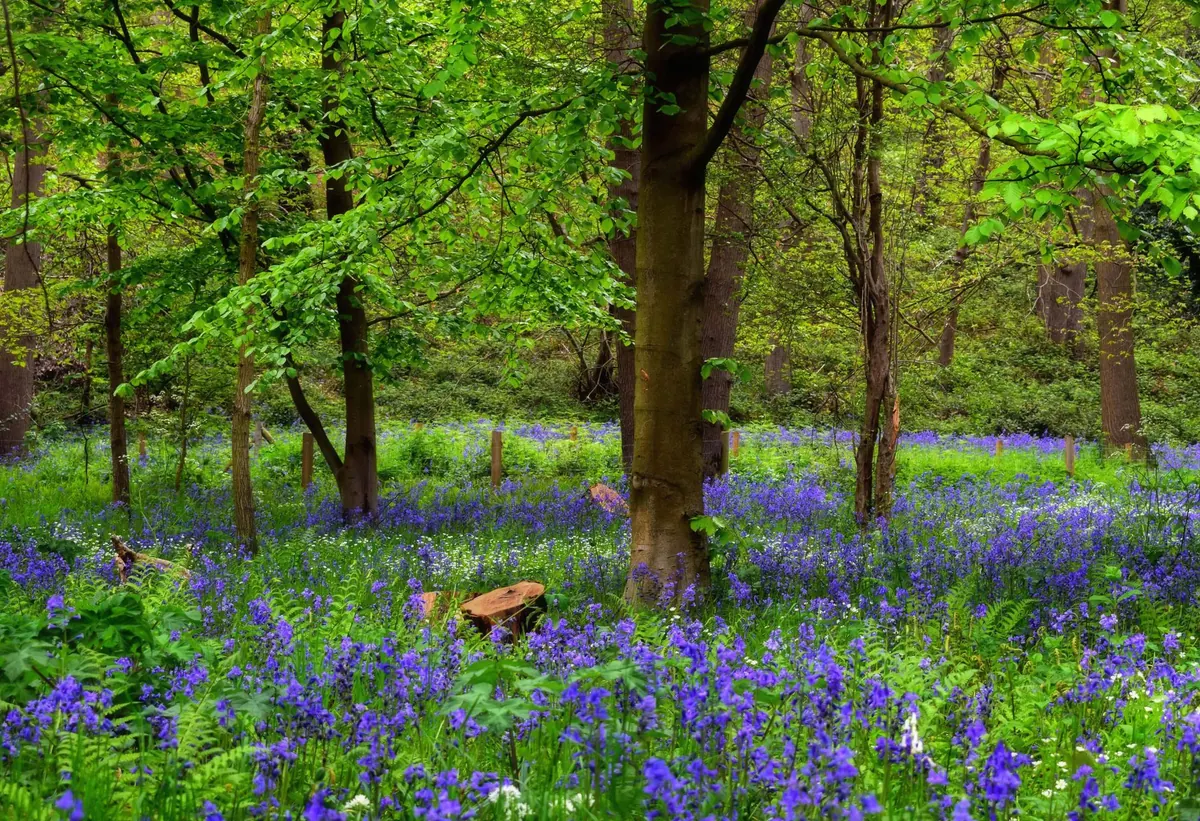
Bluebells and ruins are a natural pairing. The flowers arrive just as the woodland canopy closes, and the best places to see them often have a folly or a broken abbey at the end of the path. A drift of native bluebells under beech and oak, with a crumbling tower or a sham castle beyond, is one of the great British spring walks.
The catch is that bluebell season is short and local. A wood can be blue one week and green the next. The following guide covers timing, six routes worth planning around, and the small decisions that keep these fragile places healthy for another year.
Read the season before you set out
Bluebell timing is never a single date. In mild, low-lying parts of the south and south-west, the first flowers can appear in early April, while upland woods and northern sites may not turn blue until late May or even early June. Altitude, aspect, soil type and the closing of the canopy all shift the peak by a week or two in either direction. A south-facing slope in Devon can be at its best while a north-facing wood in the Pennines is still in tight bud.
Rather than trusting a calendar, watch for the signs. Bluebells usually open as the first oak leaves unfurl and the wood anemones begin to fade. A week of warm, damp weather can push a wood from green to violet almost overnight. Local wildlife trusts, National Trust pages and estate websites often post weekly updates; a quick phone call to a visitor centre can save a wasted journey.
Tip: If you only have one free weekend, aim for the last week of April in the south and the first two weeks of May in the north. That window catches the majority of lowland and mid-elevation woods.
What makes a good bluebell ruin walk
Not every ruined castle or folly sits beside a bluebell wood. The best sites share a few quiet ingredients: ancient woodland that has never been ploughed, well-drained but moisture-retentive soil, and a ruin that opens the canopy just enough to let spring light through. Follies and abbeys were often built on estates that kept old coppice woods for game and timber, which is why they so often coincide with bluebells today.
- Ancient woodland: Bluebells are slow to spread, so a wood that has been continuously wooded for centuries is a good sign.
- A ruin or folly: Broken walls and towers create shelter, microclimates and photogenic framing.
- Paths and open rides: Wider paths let you admire the flowers without stepping into the drifts.
- Variety: The best walks mix bluebells with wood anemone, wild garlic and early purple orchid.
Six routes worth planning around
These are not the only places to see bluebells around ruins, but they are reliable, varied and easy to research before you travel. Check opening times, parking and any seasonal restrictions before setting out.
1. Fountains Abbey and Studley Royal, North Yorkshire
The ruins of Fountains Abbey are among the largest in England, and the surrounding deer park and woodland carry fine drifts of native bluebells in late April and early May. Walk from the abbey along the river to the Seven Bridges Valley, then climb towards the deer park for views back over the ruins. The combination of Cistercian stonework and spring woodland is hard to beat.
2. Corfe Castle, Dorset
Corfe Castle stands on a ridge above the Purbeck Hills, and the woods below the castle and along the ridge to Swyre Head are rich in bluebells. The ruin itself is a dramatic silhouette, and the surrounding heath and woodland offer a longer walk. Come early to avoid the crowds and to catch the morning light on the castle walls.
3. Hardwick Old Hall, Derbyshire
Hardwick Old Hall is a romantic ruin next to the Elizabethan Hardwick Hall. The parkland and adjoining woodland have bluebells in spring, and the old hall’s crumbling walls make a striking backdrop. The walk is gentle, with plenty of options to extend into the surrounding countryside.
4. Stowe Gardens, Buckinghamshire
Stowe is famous for its follies, temples and bridges, and the woodland gardens around the lakes and ponds are dotted with bluebells. The scale is grand, so you can walk for hours and still find quiet corners. Look for the Temple of Concord and Victory, then follow the paths into the woods where the bluebells gather.
5. Hafod Estate, Ceredigion, Wales
The Hafod Estate is a ruined mansion set in a dramatic valley of waterfalls, bridges and ancient woodland. In spring, the woods along the Ystwyth river are carpeted with bluebells. The estate is criss-crossed with waymarked walks, so you can choose a short loop or a longer circuit that takes in the ruins and the river gorge.
6. Bodiam Castle, East Sussex
Bodiam’s moated castle looks almost too perfect, but the surrounding woods and the banks of the River Rother have good bluebell displays. The walk along the river and through the adjacent woodland is flat and easy, making it a good choice for families. The castle provides the folly-like finale.
The small decisions that keep these fragile places healthy
Bluebells are surprisingly fragile. Their bulbs sit close to the surface, and a single heavy footstep can crush leaves and bulbs that took years to establish. A wood that is loved to death can lose its bluebells in a few seasons. The good news is that a few simple choices make a real difference.
- Stay on the path. Even if the bluebells look sturdy, they are not. Trampling compacts the soil and damages the bulbs.
- Never pick bluebells. It is illegal to uproot native bluebells, and picking the flowers prevents seed set.
- Keep dogs on a short lead. Dogs can crash through the drifts and disturb ground-nesting birds.
- Take photos, not plants. A close-up with a low angle can look as good as a picked bunch.
- Leave no trace. Take litter home, and avoid blocking paths or gateways.
Many bluebell woods are on private estates or nature reserves. Respect any signs, closures and requests to keep to certain routes. If a path is muddy, walk through the mud rather than around it—widening the path damages the woodland edge.
Native or Spanish? A quick field guide
Not all bluebells are the same. The native British bluebell (Hyacinthoides non-scripta) is the one you want to see in ancient woodland. The Spanish bluebell (Hyacinthoides hispanica) is a garden plant that has escaped into the wild and hybridises with the native species. The differences are subtle but learnable.
- Native bluebell: Deep violet-blue, narrow leaves, drooping flower heads that hang to one side, cream-coloured anthers, and a sweet, heavy scent.
- Spanish bluebell: Paler blue, often pink or white, broader leaves, upright flower spikes, blue anthers, and little or no scent.
- Hybrids: Variable, but often show a mix of features—paler flowers, some scent, and anthers that are not quite cream or blue.
Why does it matter? Native bluebells support more insects and are part of the historic character of an ancient wood. If you see Spanish bluebells in a wild setting, do not dig them up or spread them; report them to the landowner or local wildlife trust if you can.
Beyond bluebells: other spring sights around ruins
Bluebells are the headline act, but they are not the only reason to walk. Around ruined abbeys, castles and follies you may also find wood anemone, lesser celandine, wild garlic, early purple orchid and dog’s mercury. The bare branches of early spring let you see the architecture of the ruin more clearly, and birdsong is at its peak.
Ruins themselves are wildlife habitats. Owls, kestrels, bats and invertebrates use the cracks and crevices of old walls. A walk that combines natural history with history is doubly rewarding: you can admire the stonework, then look down to see the flowers, then look up to watch a buzzard circling the tower.
Finally, remember that bluebell season is a fleeting pleasure. Go gently, go early, and let the wood keep its blue for another year.